


Table of contents
- Why skin loses elasticity with age
- What you need before you start: the basics and your skin's condition
- Hyaluronic acid for skin: hydration and plumping
- Retinol for wrinkles: getting started and managing irritation
- Skin-firming care: peptides and collagen-supporting ingredients
- Skincare for sensitive skin: introducing new products safely
- Your practical morning and evening routine for greater elasticity
- Realistic timelines and measurable changes
- Frequently asked questions
Last updated: October 9, 2026
Why skin loses elasticity with age
Skin elasticity depends directly on collagen and elastin, the proteins that provide structure and firmness.
From the age of 30, collagen production declines by approximately one percent per year. UV radiation, environmental stressors and metabolism further break down these fibers.
The skin barrier also becomes thinner and retains less moisture, so dehydration contributes to wrinkles too.
The right skincare for elasticity can slow and partly reverse this process, not with miracle products, but with proven ingredients and a consistent routine.
What you need before you start: the basics and your skin's condition
Before buying anything, identify three things: your skin type, its current condition and your goals. Otherwise, you could spend weeks dealing with irritation instead of making progress.
Skin types differ fundamentally:
- Dry skin: Feels tight and rough, often with visible fine lines caused by dryness. The barrier is weakened and transepidermal water loss is increased.
- Oily skin: Looks shiny but can still be dehydrated, a fact often overlooked in self-assessments. Oil production and moisture levels are two separate systems.
- Combination skin: Oily in the T-zone (forehead, nose, chin), dry on the cheeks. Often requires care tailored to each area.
- Sensitive skin: Quickly reacts to new products with redness, burning or itching. The skin barrier is more permeable, allowing active ingredients to penetrate faster and more deeply.
Skin condition is not the same as skin type: you can have oily skin with a loose texture or dry skin with acne. Skin condition changes with the seasons, stress, hormones and your skincare history.
Which active ingredients suit which skin types
The key question isn't "Which product is best?" but "Which active ingredient can my skin tolerate, and at what concentration?".
| Skin type | Well tolerated | Use with caution | Best avoided |
|---|---|---|---|
| Dry | Hyaluronic acid, peptides, squalane, ceramides, glycerin | Retinol (low concentration, introduced gradually) | High-strength acid peels |
| Oily | Niacinamide, hyaluronic acid (lightweight serum), peptides, salicylic acid | Retinol (may initially cause purging) | Heavy oils, rich butter-based creams |
| Combination | Tailor care by area: lightweight serum all over, richer cream only on the cheeks | Retinol (start on dry areas) | Using the same products all over the face |
| Sensitive | Hyaluronic acid, peptides, panthenol, ceramides | Retinol (only after 4-6 weeks, at a very low concentration) | Fragrances, essential oils, high-strength vitamin C, exfoliants |
Documenting your skin's condition
Before you start, note the following:
- Where are the first signs of aging appearing? (Eyes, forehead, neck, décolletage)
- Does your skin feel firm or loose?
- Is it dry, oily or combination?
- Does it react sensitively to new products?
- How many active ingredients are you already using?
This determines which active ingredients you need and how quickly you can introduce them.
Recognizing irritation and responding appropriately
Not every reaction means you need to stop. There is an important distinction:
- Adjustment reaction (normal): mild tingling, tightness and minimal flaking in the first 1-2 weeks after starting retinol. It subsides when you reduce the frequency of use.
- Genuine intolerance (stop using the product): redness lasting more than 48 hours, burning, hives or itching. Stop using the product and limit your routine to cleansing, moisturizing and sun protection until your skin has calmed down.
Setting realistic expectations for your skin assessment
Observe your skin morning and evening for a week and note when it feels tight, looks shiny or reacts. This can save you weeks of trial and error later.
Hyaluronic acid for skin: hydration and plumping
Hyaluronic acid is not an acid peel; it's a moisture magnet.
One hyaluronic acid molecule binds 1000 times its own weight in water. Skin looks plumper and fine lines caused by dryness become less visible.
Important: Hyaluronic acid plumps the skin but does not create new structural proteins. Without a moisturizer, the plumping effect fades after a few hours.
Here's why hyaluronic acid is still essential:
When skin is dehydrated, other anti-aging ingredients don't work: a dried-out barrier is permeable and easily irritated. Hyaluronic acid helps stabilize it.
The hyaluron⁵ collagen booster serum concentrate combines a five-part hyaluronic acid formula with highly effective tripeptides that can stimulate the skin's own collagen production, making your skin look younger, plumper and firmer.

Apply hyaluronic acid serum to damp skin. Damp skin draws the water in more deeply. Follow with a moisturizer to lock it in.
Retinol for wrinkles: getting started and managing irritation
Retinol is a classic anti-aging ingredient and the most common reason people abandon their routine.
Retinol stimulates cell turnover: old cells are shed faster and new ones appear sooner. This visibly reduces wrinkles.
Here's how to introduce retinol properly:
Start with the lowest concentration, two to three times a week.
Don't immediately combine retinol with vitamin C, acid peels or benzoyl peroxide; give your skin time to adjust.
Use rich moisturizers: retinol dries out the skin, and a lightweight day cream isn't enough.
Sun protection is not optional. Retinol makes skin more sensitive to light. Without UV protection, sun damage can undo all your progress.
Skin-firming care: peptides and collagen-supporting ingredients
While hyaluronic acid plumps and retinol boosts cell turnover, peptides work on the skin's structure itself.
Peptides are short chains of amino acids that signal to the skin: "Produce more collagen."
This takes longer than the plumping effect of hyaluronic acid: after four to eight weeks, skin becomes firmer and wrinkles less pronounced.
The concentrates total lift boost by Wellmaxx Swiss contains SYN®-AKE alongside a combination of three types of hyaluronic acid. SYN®-AKE is a synthetic peptide developed using temple viper venom as a model. It relaxes facial muscles, thereby reducing the appearance of wrinkles. Expression lines are visibly reduced!

Peptides work best with consistent daily use. Four weeks is the minimum; after eight weeks, most people see noticeable improvements.
Skincare for sensitive skin: introducing new products safely
Sensitive skin needs a different approach: don't introduce three new active ingredients at once.
Rules for sensitive skin:
Introduce one new active ingredient per week and monitor your skin's reaction. If there is no irritation, introduce the next one.
Start with the gentlest active ingredients: hyaluronic acid and peptides. After four to six weeks, you can cautiously introduce a low concentration of retinol.
Never use multiple active ingredients on the same evening: no retinol with vitamin C or an acid peel.
Do a patch test: apply the new product behind your ear or on your forearm first, then wait 24 hours.
Keep your routine simple. The fewer products you use, the less can go wrong. Three to four good products are better than ten mediocre ones.
The most common mistake with sensitive skin
The mistake isn't choosing the wrong product, but using too much at once. If you introduce three new serums in one week, you won't know which caused the redness and will have to stop using all of them.
Body care for loose skin: neck, décolletage, arms and legs
Loss of elasticity doesn't just affect the face: the neck, décolletage, upper arms and thighs lose firmness too. The skin on the neck and décolletage is thinner than on the face and visibly ages faster.
Why skin on the body responds differently:
- Skin on the body is thicker but drier; it has fewer oil glands than the face.
- It is exposed to daily stress from clothing, friction and showering.
- It is rarely protected with sunscreen, even though the décolletage and hands are among the areas most exposed to UV rays.
What loose skin on the body needs:
The same active ingredients work on the body too, but in a richer base formula, because the skin barrier needs more oil:
collagen velvety skin smoothing body cream →
- Hyaluronic acid for immediate hydration and plumping
- Peptides for long-term collagen support
- Collagen as a film-forming ingredient for smoother-feeling skin
- Squalane and shea butter as an occlusive layer that locks in moisture
- Niacinamide to support the skin barrier and promote a more even skin tone
Apply body care products to slightly damp skin after showering to significantly improve absorption. Massage toward the heart to support circulation.
Don't forget sun protection for your body
The most effective protection against loss of elasticity on the body is the same as for the face: UV protection. The décolletage, back of the neck, backs of the hands and forearms are the areas most often left unprotected, and these are precisely where the first signs of lost firmness appear. A lightweight body lotion with SPF or a spray-on sunscreen fills this gap with little effort.
When to see a professional about sensitive skin
If your skin continues to react with redness, burning or flaking after four weeks of minimalist skincare, it could indicate a skin barrier condition or contact allergy. A dermatological assessment is more useful at that point than trying another product.
Your practical morning and evening routine for greater elasticity
Theory is all well and good. But you need a plan you can put into practice tomorrow.
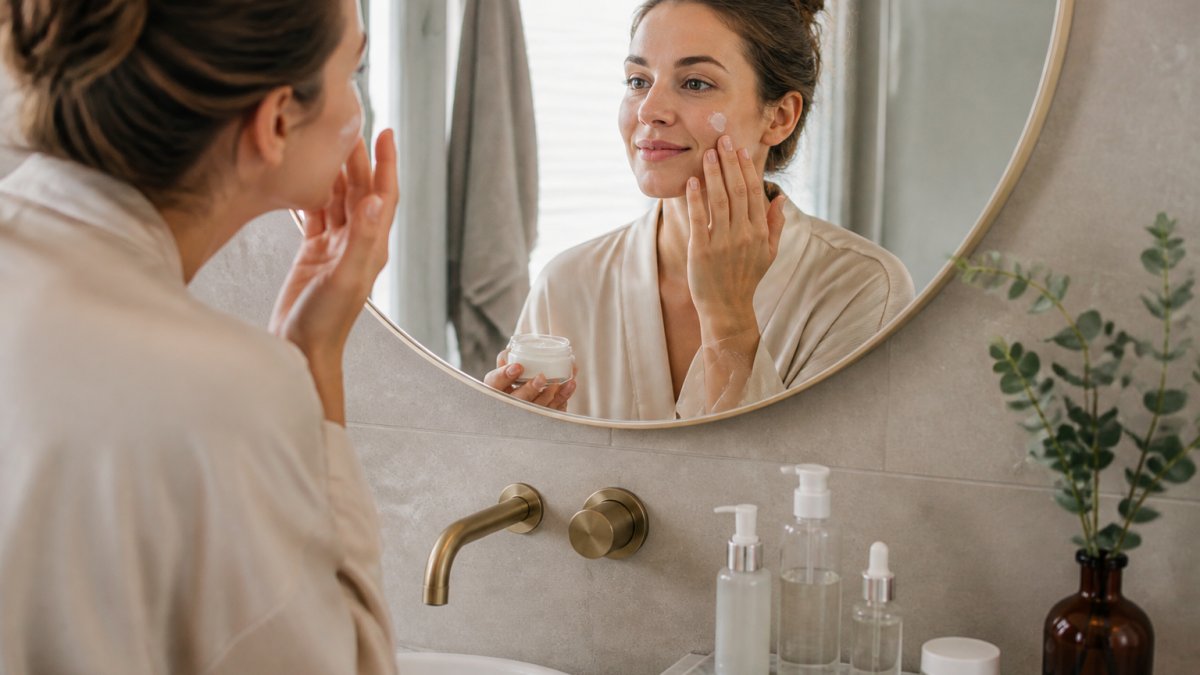
Morning routine: protection and preparation
The morning routine takes five minutes. It protects your skin and prepares it for the day.
Step 1: Cleanser (30 seconds)
Wash your face with lukewarm water and a gentle cleanser; water that is too hot dries out the skin.
Step 2: Toner or hydrosol (optional, 30 seconds)
A toner balances pH. It's not essential, but it can help. Pat it in gently; don't rub.
Step 3: Serum (60 seconds)
Apply the hyaluronic acid serum while your skin is still damp so it absorbs more deeply. Spread two to three pumps in circular motions without rubbing.
The hyaluron⁵ day & night fluid concentrate is a silky 24-hour skincare concentrate that provides skin with highly effective five-part hyaluronic acid for a more vibrant, youthful appearance.
Step 4: Day cream (60 seconds)
Apply a pea-sized amount of lightweight moisturizer to seal in the serum and protect against environmental stressors.
Step 5: Sunscreen (60 seconds)
This is not optional. Sunscreen is the most important anti-aging product of all. UV radiation directly damages collagen.
Use at least SPF 30, applying it after your cream has absorbed.
Evening routine: regeneration and intensive care
The evening routine takes longer: skin regenerates at night, making it the best time for potent active ingredients.
Step 1: Cleanser (90 seconds)
Wash your face thoroughly and remove makeup, sweat and dirt.
Step 2: Toner (30 seconds)
As in the morning. Optional, but helpful.
Step 3: Active ingredient (60 seconds)
If you're new to retinol: use it two to three times a week, increase to four to five times after two weeks, and use it daily after four weeks.
Step 4: Peptide serum (60 seconds)
The hyaluron⁵ collagen booster serum concentrate fits perfectly here: peptides for collagen production and hyaluronic acid for hydration.
Step 5: Night cream (60 seconds)
A rich night cream is essential: it seals in all the active ingredients and can be richer than your day cream.
The collagen velvety skin smoothing body cream contains hydrolyzed marine collagen (vegan), hyaluronic acid, squalane, rice germ oil and shea butter.

Step 6: Eye cream (30 seconds)
The skin around the eyes is thin, sensitive and shows signs of aging first.
Realistic timelines and measurable changes
Here's the uncomfortable truth: real changes in your skin take time.
You'll see the surface plumping effect of hyaluronic acid immediately. It's real, but not permanent. Without a moisturizer, the effect fades after a few hours.
Deeper changes take longer:
- Four weeks: Your skin feels better. More hydrated. Less rough. Fine lines caused by dryness are less visible.
- Eight weeks: Fine lines become less pronounced. Skin texture improves. Your skin looks more even. This is when most people say, "This really works."
- Twelve weeks: Deeper wrinkles become less pronounced. Skin firming is clearly visible. Skin feels firmer. This is no longer a placebo effect. These are real structural changes.
Many people give up after two weeks because they don't see dramatic results, but that's too soon.
Take photos on day one and after four, eight and twelve weeks, using the same lighting and angle. The differences will be clear.
Sleep, water, diet and stress affect your skin just as much as products do. Skincare for elasticity works best alongside a healthy lifestyle.
Effective skincare for greater elasticity is no secret. The hyaluron⁵ collagen booster serum concentrate and the concentrates total lift boost combine multiple active ingredients in one formula.
Frequently asked questions
How long does it take to see the first results from my skincare routine for greater elasticity?
Initial improvements in skin hydration and radiance are often visible after 2-3 weeks. Measurable improvements in skin firmness and fine lines usually appear after 6-8 weeks of consistent use. Deeper wrinkles and significant improvements in elasticity require 8-12 weeks or longer. Consistency is key: daily use morning and evening delivers the best results.
Which active ingredients are most effective at supporting skin elasticity?
Hyaluronic acid hydrates and plumps the skin, making wrinkles less visible. Retinol promotes skin renewal and boosts collagen production for long-term firmness. Peptides such as SYN®-AKE relax facial muscles and reduce expression lines. Vitamin C and antioxidants protect against premature skin aging. Ceramides and glycerin strengthen the skin barrier and retain moisture.
I have very sensitive skin - how can I introduce new products safely?
Start with one new product per week so you can identify any intolerances. First, test it on a small area of skin for 2-3 consecutive days. Avoid introducing multiple active ingredients, such as retinol and vitamin C, at the same time. Start with low concentrations or less frequent use (e.g., retinol once a week). Always use a moisturizer to help stabilize the skin barrier.
Is it normal for my skin to peel after using retinol?
Mild flaking in the first 2-4 weeks is normal and shows that retinol is working: it promotes skin renewal. Intense peeling or redness suggests excessive irritation. Reduce the frequency (e.g., every other day instead of daily) or the concentration. Always use a rich moisturizer after retinol and temporarily avoid other active ingredients such as vitamin C or acids.


