

Table of Contents
- What Mature Skin Over 40 Really Needs
- Anti-Aging Active Ingredient Comparison: What Is Scientifically Proven?
- Retinol Use Over 40: Opportunities and Limits
- Skincare Routine Over 40: How to Combine Active Ingredients Correctly
- The Best Anti-Aging Cream Over 40: Concentrates and Serums Compared
- Skin-Type-Specific High-Tech Routines for Optimal Results
- Realistic Expectations and Conclusion
- Frequently Asked Questions
Last updated: 13 September 2026
What Mature Skin Over 40 Really Needs
The best anti-aging cream over 40 is not a question of price, but of active-ingredient combination: from this age onward, cell renewal slows down, collagen synthesis declines, and the skin barrier becomes more permeable. Anyone who understands this will shop differently.
This guide from Wellmaxx Swiss explains which high-tech active ingredients really make a difference, how to use retinol correctly, and which concentrates can be sensibly combined. We first look at what changes in the skin before talking about products. Otherwise, you end up buying active ingredients that miss the actual problem.
Changes in the Epidermis and Dermis
The epidermis renews itself more slowly, the stratum corneum becomes thinner and more uneven. In the dermis, the density of collagen and elastin fibers decreases, while free radicals and UV damage from earlier years leave their marks. The result: wrinkles, loss of elasticity, and a dull complexion.
Two terms determine the product choice:
- Epidermis: the outermost layer of skin, responsible for the barrier and moisture retention. Active ingredients such as ceramides and hyaluronic acid work here.
- Dermis: the layer below with collagen and elastin. Peptides and retinoids target this level.
A common mistake is to care for only one of the two layers. Moisture without structure looks plumped up, but not firmer.
Anti-Aging Active Ingredient Comparison: What Is Scientifically Proven?
The anti-aging active ingredient comparison shows a clear picture: well documented are hyaluronic acid, niacinamide, vitamin C, peptides, and retinoids. Biotechnological active ingredients such as SYN®-AKE or Matrixyl™ add to this base, but do not replace it. The key is the active ingredient concentration and whether a substance can even pass through the skin barrier. Many products name the active ingredient but do not disclose the dosage.
What most guides leave out: they claim "scientifically proven" without distinguishing the type of evidence. That matters for purchasing decisions, because a substance may have been tested in vitro (in a test tube), ex vivo (on skin models), or in controlled clinical studies on humans. Only the last category justifies a strong efficacy claim.
What the Levels of Evidence Mean in Practice
- In vitro data: show that a substance stimulates collagen synthesis in cell cultures. Relevance for human skin: limited.
- Ex vivo data: obtained from skin models or biopsies. Closer to reality, but without the circulation and immune system of a living organism.
- Clinical studies in humans: measure wrinkle depth, elasticity, or moisture over weeks. These studies are the most reliable basis.
A manufacturer that names a clinical study and states the number of participants, duration, and measurement method is more credible than one that only says "scientifically tested".
Hyaluronic Acid, Peptides and Ceramides
Hyaluronic acid binds water and plumps up the skin, with short-chain variants penetrating deeper than long-chain ones. Peptides give the skin signals to boost collagen synthesis. Ceramides seal the barrier and reduce transepidermal water loss.
What most guides leave out: a combination of several hyaluronic acid sizes works differently from a single fraction. Concentrates with triple or quintuple hyaluronic acid cover both the surface and deeper layers at the same time. With niacinamide, 2 to 5 percent is well tolerated by most skin types; higher concentrations more often irritate sensitive skin. With vitamin C, formula stability is crucial, because pure L-ascorbic acid oxidizes quickly in light and air and then loses its effect.
Biotechnological Active Ingredients and Collagen Synthesis
Biotechnological active ingredients are lab-created peptides designed to influence muscle contractions or cell processes in a targeted way. SYN®-AKE, for example, is modeled on temple viper venom and can visibly reduce expression lines without freezing facial expression. Matrixyl™ is a palmitoyl peptide that stimulated collagen and elastin synthesis in studies on skin models.
These ingredients are not a substitute for sunscreen. Without daily UV protection, you are working against the cause of most skin aging.
The Comparison in Practice
| Active ingredient | Evidence base | Typical concentration | Main benefit |
|---|---|---|---|
| Hyaluronic acid | good, clinical | 0,1-2 % | Moisture, plumping |
| Niacinamide | good, clinical | 2-5 % | Barrier, pore appearance, pigmentation |
| Vitamin C | good, clinical | 8-20 % | Antioxidant, brightening |
| Peptides (Matrixyl™) | moderate, ex vivo | 2-5 % | Collagen signals |
| Retinoids | very good, clinical | 0,01-0,1 % (retinol) | Cell renewal, wrinkles |
| SYN®-AKE | moderate, clinical | 2-4 % | Expression lines |
The table shows the core of the comparison: not every "high-tech active ingredient" has the same level of proof. Retinoids and vitamin C are best documented, peptides and biotechnological substances are promising but less strongly supported. Knowing this helps you shop more precisely.
Retinol Use Over 40: Opportunities and Limits
Using retinol over 40 is effective, but it does not forgive impatience. Retinol speeds up cell renewal, smooths skin texture, and softens pigmentation changes. It takes eight to twelve weeks before you see this in the mirror.
How to build it up:
- Start with two evenings a week at a low concentration
- After four weeks, increase to every other evening
- Only switch to daily use after eight weeks
- Always wear sunscreen in the morning
- If redness occurs, pause and strengthen the skin barrier with ceramides
Anyone under 40 with sensitive skin should test retinaldehyde instead of retinol. It works more directly, but in low doses it is often better tolerated.
Skincare Routine Over 40: How to Combine Active Ingredients Correctly
The skincare routine over 40 follows a sequence that protects active ingredients instead of neutralizing them. Rule of thumb: from thin to thick, from water-soluble to oil-soluble.
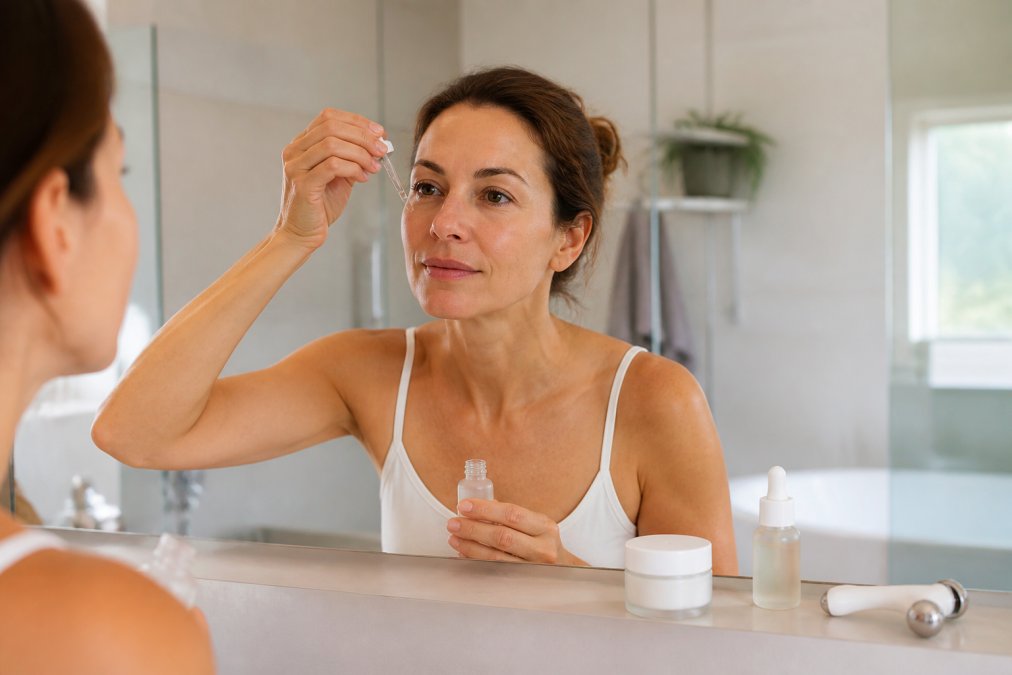
Morning: cleansing, vitamin C, moisture, sunscreen. Evening: cleansing, active concentrate, serum, cream. Anyone using a beauty tool applies it after the concentrate so the ion technology can support absorption.
Layering: Avoiding Interactions Between Active Ingredients
Not every combination works well together. Some active ingredients cancel each other out, others increase irritation.
| Combination | Assessment | Note |
|---|---|---|
| Hyaluronic acid + peptides | Safe | Apply together |
| Vitamin C + sunscreen | Recommended | Combine in the morning |
| Retinol + vitamin C | Caution | Use at different times of day |
| Retinol + peptides | Compatible | Peptides in the morning, retinol in the evening |
| Niacinamide + vitamin C | Usually safe | Separate if irritation occurs |
The Best Anti-Aging Cream Over 40: Concentrates and Serums Compared
The best anti-aging cream over 40 does not exist as a single product, but as a coordinated combination of concentrate and cream. Concentrates deliver the active ingredients; the cream seals them in and protects the barrier.
Wellmaxx Swiss focuses exactly there. The concentrate line works with multiple hyaluronic acids, peptides, and biotechnological active ingredients, dermatologically tested and designed for mature skin.
| Product | Price | Key active ingredient | Best for |
|---|---|---|---|
| concentrates total lift boost | CHF 29.00 | triple hyaluronic acid, SYN®-AKE | Expression lines, firmness |
| concentrates anti wrinkle boost | CHF 29.00 | Easyliance, hibiscus | Immediate firming |
| concentrates super hydra boost | CHF 29.00 | quadruple hyaluronic acid, marine collagen | Dryness, moisture reservoir |
| skineffect super hyaluron concentrate | CHF 36.50 | hyaluronic acid, Matrixyl™, 3 peptides | Expression lines, 7-day treatment |
| hyaluron⁵ collagen booster serum | CHF 52.50 | quintuple hyaluronic acid, tripeptide | Collagen synthesis, firmness |
| cellular lift line release serum | CHF 65.00 | Peptide technology | Regeneration, lifting |
| skineffect anti-age even skin serum | CHF 65.50 | Neutrazen™, panthenol | Sensitive, irritated skin |
| Hyaluron Anti-Aging Set | CHF 107.55 | quintuple hyaluronic acid, hydrosystem | Complete routine |
If you have deep wrinkles around the eyes, choose total lift boost or the skineffect super hyaluron concentrate. Both work with peptides that minimize muscle contractions. For sensitive skin, the even skin serum is the safer choice because it soothes instead of irritating.

The honest limitation: no concentrate replaces a cream with sunscreen. Anyone who uses only the serum and skips UV protection loses part of the effect.
Skin-Type-Specific High-Tech Routines for Optimal Results
Skin-type-specific high-tech routines determine whether an active ingredient works or irritates. The same formula can shine on oily skin and feel tight on dry skin. Most guides list active ingredients individually, but do not explain how to dose and build up potent substances like retinoids depending on skin type. That is exactly the difference between a routine you can stick with for twelve weeks and one that is abandoned after two.
Dry Skin Over 40
Dry skin has a weakened barrier and loses more water. Here, high-tech active ingredients must first strengthen the barrier before they can work structurally.
- Base: super hydra boost with multiple hyaluronic acids on slightly damp skin.
- Barrier: ceramides in the evening, followed by a rich cream.
- Building up actives: start retinol only after four weeks of barrier care, with two evenings a week and a low concentration.
- Evening order: cleansing, hyaluronic concentrate, ceramide cream, retinol before that if needed.
Oily Skin Over 40
Oily skin over 40 often produces less sebum than it did at 20, but it still shines. Heavy creams can encourage blemishes here.
- Base: light fluid instead of rich cream.
- Regulation: niacinamide at 2 to 5 percent in the morning.
- Building up actives: retinol is usually well tolerated, but still introduce it gradually.
- Evening order: cleansing, niacinamide serum, light fluid.
Sensitive Skin Over 40
Sensitive skin reacts to acids, fragrance, and high active-ingredient concentrations with redness and burning. Here, tolerance matters more than speed of effect.
- Base: even skin serum with calming ingredients such as panthenol.
- Building up actives: no acids in the first few weeks, test retinaldehyde instead of retinol since it is often better tolerated in low doses.
- Evening order: cleansing, calming serum, cream.
Mature Skin with Pigmentation Spots
Pigmentation spots result from UV damage from earlier years and become more visible after 40. The combination of antioxidant and retinoid is useful here, but it requires consistency with sun protection.
- Morning: vitamin C, moisture, sunscreen.
- Evening: retinol, then cream.
- Important: without daily sunscreen, pigmentation spots return, regardless of active-ingredient quality.
Beauty Tools in the Skin-Type-Specific Routine
A beauty tool such as the LiFTmee IONIC Beauty Light can be integrated into any of these routines. Red light supports absorption of the active ingredients, while blue light soothes. If you want more, combine the LiFTmee Dermalift Pro 6in1 after the serum. For sensitive skin, start with a low intensity so the skin can get used to the light treatment.
Realistic Expectations and Conclusion
Moisture and smoothing are often visible after two to four weeks. Reduction of wrinkles and firmness take eight to twelve weeks. Anyone who gives up after a week never tested whether the product works.
According to information from the Federal Food Safety and Veterinary Office on cosmetic products, cosmetics may not promise a healing effect. That is precisely why it is worth looking at the declared active ingredients rather than advertising claims.
When choosing, check the active ingredient concentration, look for dermatological testing, and choose a routine you can stick with for twelve weeks. The concentrates from Wellmaxx Swiss are a sensible starting point because they can be combined rather than contradicting each other.
Frequently Asked Questions
Which ingredients in anti-aging creams are scientifically proven?
Well-studied active ingredients include hyaluronic acid, peptides such as Matrixyl™ and SYN®-AKE, niacinamide, vitamin C, and ceramides. These substances demonstrably support moisture supply, the skin barrier, and collagen synthesis. Retinol and retinaldehyde are also among the proven active ingredients. The key is the active ingredient concentration and the stability of the formula, not just the list on the packaging.
How long does it take to see initial results?
Moisturizers often make the skin feel smoother after just a few days because transepidermal water loss decreases. Visible changes in wrinkles and skin elasticity usually take four to twelve weeks of regular use. Concentrates with immediately firming peptides can deliver a noticeable short-term effect, while building skin structure takes time. A consistent routine matters more than switching products quickly.
Can creams really slow skin aging?
Creams cannot stop skin aging, but they can slow it down and improve appearance. Active ingredients such as antioxidants neutralize free radicals, hyaluronic acid plumps the skin, and peptides stimulate collagen synthesis. Together with sunscreen and a stable routine, skin texture can be visibly smoothed and firmed. Realistic expectations remain important: skincare supports the skin, but does not replace dermatological treatment.
What should you look for when buying anti-aging products?
Look for clear active ingredient information, dermatological testing, and a formula that suits your skin type. For sensitive skin, soothing ingredients such as panthenol or Neutrazen™ make sense. If you already have a routine, you can add a concentrate selectively instead of changing everything. Serums and concentrates are more highly dosed than creams and are suitable for targeting specific concerns such as wrinkles or lack of moisture.
Mature skin does not need ten products, but the right ones. Wellmaxx Swiss combines 5-fold hyaluron, peptides, and biotechnological active ingredients in dermatologically tested formulas designed for cell renewal, hydration, and firming. Start with the Hyaluron Anti-Aging Set or a single concentrate and observe your skin over twelve weeks. Discover now and find the routine that suits your skin type.


