


Table of contents
- Why sensitive skin needs time to adjust
- Patch test for cosmetics: step-by-step guide
- Gentle cleansing methods for the transition
- Purging in skincare: when is it normal?
- Skincare routine for sensitive skin: the right structure
- Avoid common mistakes during the transition
- Patience and regeneration: how long does the adjustment phase take?
- Frequently asked questions
Last updated: September 30, 2026
Why sensitive skin needs time to adjust
The skin barrier is your natural shield. Getting sensitive skin used to new care means consciously managing this process, not simply switching everything at once and hoping it works.
Sensitive skin reacts more quickly to changes because the skin barrier is already weakened. New active ingredients can temporarily cause redness, tightness, or mild irritation, which often just means your skin needs time to adjust.
The skin renewal cycle takes about 28 days. Getting sensitive skin used to new care only works with a properly structured approach and patience.
Patch test for cosmetics: step-by-step guide
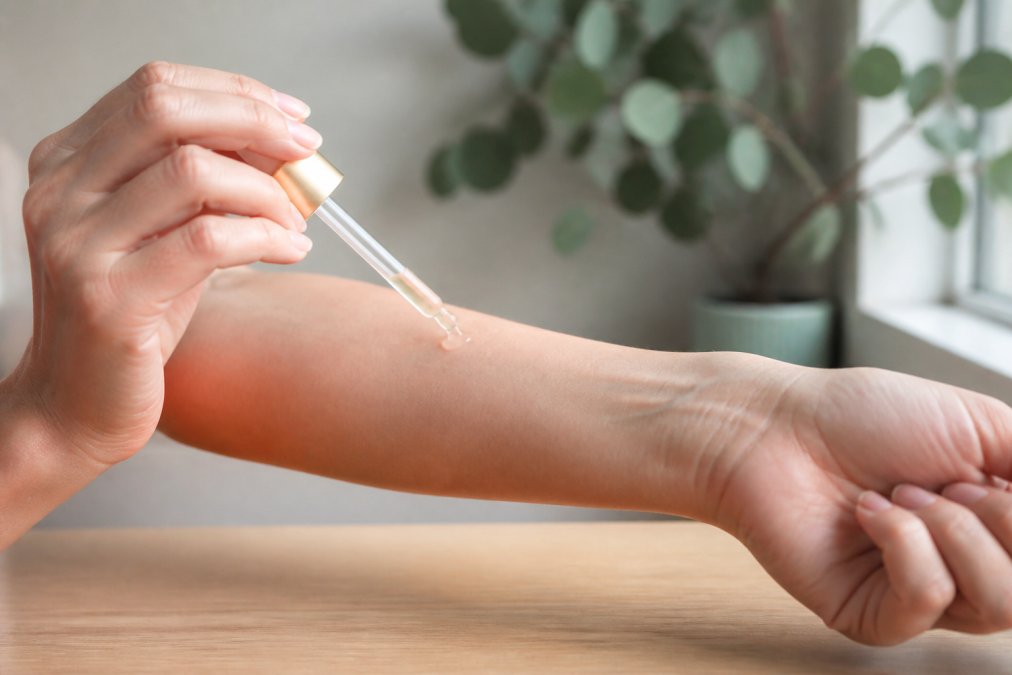
A patch test is your insurance against unexpected reactions. Before applying a new product to your entire face, test it on a small, inconspicuous area, especially important when getting sensitive skin used to new care.
Preparation and execution
Choose the inside of the forearm; it is as sensitive as your face, but not visible. Clean this area thoroughly and dry it.
Apply a pea-sized amount and let it absorb completely. Do not use any other products on this area.
The first 24 hours are crucial; watch for redness, itching, burning, or swelling.
Observation period and documentation
Keep a simple diary with the date, product, and observations; this will help identify patterns later.
After 48 hours, you can draw initial conclusions. If everything looks normal, carefully introduce the product to your face; twice a week is a good start.
Also document any reactions on the face; this information will help later when deciding whether to keep the product.
Gentle cleansing methods for the transition
Cleansing is the foundation of any skincare routine. When getting sensitive skin used to new care, gentle cleansing is even more important; an aggressive product can damage the skin barrier and make all other products ineffective.
Choosing the right cleansing formula
Use a soap-free cleansing gel or a cleansing balm. Soaps (pH 9-10) destroy your skin's natural protective layer (pH 4.5-5.5) and dry it out.
Look for cleansers with these features:
- pH between 4.5 and 6.5, This is skin-friendly and respects your skin's natural acid mantle
- No sulfates, Sulfates such as Sodium Lauryl Sulfate are too harsh and remove too much natural oil
- Soothing ingredients, Panthenol, allantoin, chamomile, or Centella Asiatica reduce irritation during cleansing
- No essential oils or alcohol, These can be irritating
Milky or creamy textures are better than watery gels for sensitive skin. They cleanse more gently and leave a protective film.
Step-by-step cleansing technique
Step 1: Prepare the water
Use lukewarm water (30-35 °C). Hot water opens the pores too much and removes too much natural oil; cold water closes the pores and prevents cleansers from penetrating.
Step 2: Apply the product
Take a hazelnut-sized amount of cleanser onto dry skin; this allows better emulsification with oil and dirt.
Step 3: Gentle massage
Massage in circular motions with your fingertips for 30-60 seconds, focusing on the T-zone. Avoid aggressive rubbing; your facial skin needs gentle treatment.
Step 4: Thorough rinsing
Rinse with lukewarm water at least 10-15 times until the water runs clear; residue can cause irritation.
Step 5: Drying
Pat dry with a soft towel, do not rub. Leave the skin about 70% dry before applying toner or serum.
Frequency and timing
Cleanse your skin twice daily: morning (sweat and oil) and evening (makeup, dirt, and environmental stressors). More is not better.
If you wear makeup, use double cleansing:
- First cleanse: A cleansing oil or balm removes makeup and waterproof products
- Second cleanse: Your gentle cleansing gel removes residue and thoroughly cleanses the skin
That may sound time-consuming, but it is necessary to remove makeup completely without irritating the skin.
Common cleansing mistakes
Common mistakes: Water that is too hot damages the skin barrier. Massaging for over 60 seconds is irritating. A hazelnut-sized amount is enough. Incomplete rinsing causes irritation. Use only a soft towel.
Purging in skincare: when is it normal?
Purging describes a temporary worsening before the skin improves. Many people give up, but it is often a good sign, though only under certain conditions.
Purging vs. irritation: the critical distinguishing factor
The most important thing is to distinguish between two completely different reactions: purging and irritation. These two processes look similar, but they require opposite actions.
Purging occurs when your product speeds up cell turnover (typical with retinol, acids, or vitamin C). Your skin brings clogged pores to the surface faster, a sign that the product is working.
Purging has these characteristics:
- Blemishes appear mainly in areas where you usually get acne
- The reaction occurs within 3-7 days
- Redness is mild to moderate and concentrated in affected areas
- Symptoms improve significantly after 2-4 weeks
- Itching or burning is minimal or absent
Irritation is a real intolerance reaction; your product does not suit your skin.
Irritation has these characteristics:
- Redness and irritation occur everywhere, not just in prone areas
- The reaction can appear immediately or within 24 hours
- Strong burning, itching, or tightness
- Symptoms do not improve or get worse after a week
- Possible swelling, blisters, or rash
Action protocol for different scenarios
Scenario 1: You suspect purging
Continue using the product, but reduce the frequency. If you use the product daily, switch to three to four times a week. This gives your skin time to process the reaction without overloading it. Otherwise, keep your routine stable; do not change anything else.
Wait two to four weeks. If the skin has not improved after four weeks, it is probably not a purging reaction, but a real intolerance.
Scenario 2: You suspect irritation
Stop using the product immediately. Wash it off thoroughly and return to your previous routine. For the next 3-5 days, use only your tried-and-true products and a soothing moisturizer.
After 5-7 days, you can perform another patch test, this time with an even smaller amount and in a different area. If the reaction returns, this product is not right for you. Do not continue testing it.
Scenario 3: Uncertainty, you do not know which reaction it is
Document carefully. Keep a diary with the date, time, and symptoms. Take daily photos of the affected areas. After one week, the patterns will become clearer.
If the symptoms improve after a week, it was probably purging. If they stay the same or worsen, it was irritation.
Normal reactions during the adjustment phase
Mild redness in the first 3-5 days is normal, especially if the product contains concentrated active ingredients. A slight feeling of tightness may occur, which means your skin is actively working. Small blemishes may temporarily appear.
However, these reactions should be mild and begin to improve after about a week.
Skincare routine for sensitive skin: the right structure
A good routine for sensitive skin is like a foundation. It has to be stable and well thought out. Too many products at once are counterproductive.
The minimalist base
Start with three products: cleanser, tonic, and moisturizer. That is all you need. Everything else is extra.
Step-by-step integration of active ingredients
After two weeks, you can add a fourth product. A serum is a good choice. The skineffect anti-age even skin serum contains Neutrazen™, an innovative tri-peptide that reduces irritation and soothes sensitive skin. Use it three to four times a week, not daily.

Avoid common mistakes during the transition
The biggest mistakes come from impatience. People want quick results and put too many new products on their skin at the same time.
Patience and regeneration: how long does the adjustment phase take?
The adjustment phase when getting sensitive skin used to new care typically lasts 4-6 weeks.
Frequently asked questions
How long does sensitive skin need to get used to new care?
The adjustment phase typically lasts 2-4 weeks, sometimes up to 6 weeks. During this time, the skin barrier goes through a regeneration cycle. With sensitive skin, adjustment can take longer because the skin reacts more sensitively to changes. Patience is key: many users see the best results only after this adjustment phase. Wellmaxx Swiss products such as the Basiccare Calming Tonic support this process with soothing ingredients like panthenol and allantoin.
What signs indicate a real intolerance to new skincare?
Distinguish between a normal adjustment reaction and a real intolerance: adjustment reactions are mild redness, minimal tightness, or temporary blemishes in the first 1-2 weeks. Signs of intolerance are strong redness, swelling, intense burning, itching, or rash that do not subside after 3-4 weeks. If you notice these warning signs, stop using the product immediately and return to your previous routine.
Should I introduce new skincare products one by one or together?
With sensitive skin, you should introduce products one by one—ideally with 1-2 weeks between each new product. This allows you to identify exactly which product triggers a reaction. Start with cleansing, then tonic, then serum, and finally nighttime care. The skineffect anti-age even skin serum was specifically developed for sensitive skin and can be added after an established cleansing routine.
How do I safely introduce active-ingredient skincare for sensitive skin?
Start with a low concentration and low frequency. Initially use highly concentrated active ingredients only 2-3 times a week, then gradually more often. The skineffect anti-age even skin serum contains Neutrazen™, a specially developed tri-peptide that reduces irritation and strengthens the skin barrier. Combine it with gentle cleansing methods and soothing products such as the Basiccare Calming Tonic to support the skin during the adjustment phase.


