

Table of contents
- Why dry skin develops after tanning beds
- Skin regeneration after tanning bed use: What matters in the first 24 hours
- Choosing tanning bed skincare products correctly
- Thalitan application: Step by step to soothed skin
- The right skincare routine after sun exposure
- Moisture from within and the role of nutrition
- Recognizing long-term effects and strengthening the skin barrier
- Conclusion
- Frequently asked questions
Last updated: 21 September 2026
Why dry skin develops after tanning beds
Dry skin after tanning beds is not hypersensitivity, but a measurable result of UV radiation. UV radiation attacks the skin barrier, and moisture loss increases noticeably. If you are looking for tips against dry skin after tanning bed use, Wellmaxx Swiss offers clear guidance here: first understand what happens in the skin, then take the right action.
UV radiation and moisture loss in the skin barrier
The skin barrier is the outermost protective layer of the skin. It keeps water in the tissue and harmful agents out. UV light damages this layer directly.
The consequences:
- The lipid balance becomes unbalanced
- Moisture escapes more quickly through the skin surface
- Sebum production responds with compensatory regulation
In short: UV-induced stress dries the skin out from the outside.
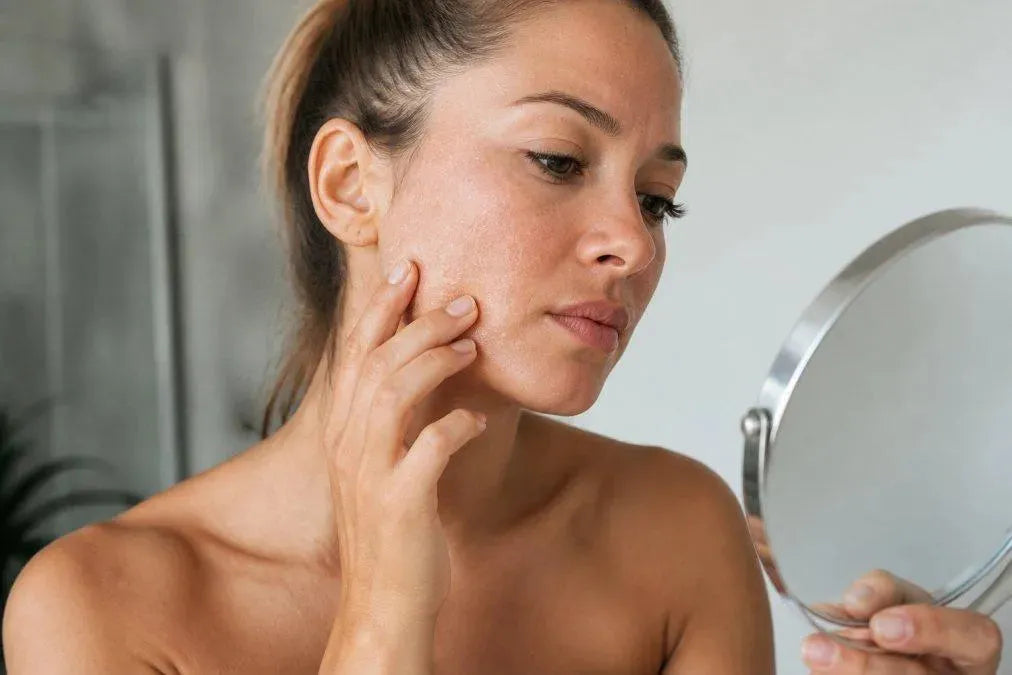
Tightness, flaking skin, and early signs
The first warning sign is usually a feeling of tightness. Then fine flakes appear, often on the cheeks, forehead, and shoulders.
Other typical signs:
- Skin redness that lasts longer than usual
- Rough patches despite applied cream
- A pulling sensation right after showering
Ignoring these signs risks skin irritation and a weakened skin barrier.
Skin regeneration after tanning bed use: What matters in the first 24 hours
Skin regeneration after tanning bed use begins immediately, but the first 24 hours determine how it goes. During this recovery phase, the skin mainly needs rest, moisture, and cooling—not friction or heat.
Specifically, this means:
- No second sunbathing session and no tanning bed use on the same day
- No exfoliation and no mechanical rubbing
- Shower lukewarm instead of hot
- Moisturize immediately after showering
According to official advice on sun protection and skin health, the best protection is still to avoid excessive UV exposure. For the time after that: care patiently instead of trying to tan more.
Choosing tanning bed skincare products correctly
Tanning bed skincare products should soothe and lock in moisture, not irritate further. The right choice determines whether the skin recovers in days or weeks. The key difference lies not in marketing promises, but in the INCI list - the international naming system for ingredients printed on every package.
Look for these properties:
- Moisture-binding ingredients such as hyaluronic acid, glycerin, or panthenol
- Antioxidants such as vitamin E (tocopherol) or vitamin C for cell protection
- Fragrance-free formulas for sensitive skin
- Light textures that absorb quickly
- Soothing active ingredients such as allantoin, bisabolol, or oat extract
Ingredients to avoid
Some ingredients make things worse. Pure alcohol in high concentrations dries the skin out further. Artificial fragrances and essential oils irritate already irritated skin. The problem: many after-sun lotions contain exactly these ingredients because they create a cooling sensation - but it only works briefly and weakens the barrier further.
These ingredients do not belong on sun-damaged skin:
- Denatured alcohol (Alcohol Denat.) near the top of the ingredient list - it evaporates quickly and removes moisture from the skin
- Exfoliating acids such as AHA (glycolic acid, lactic acid) and BHA (salicylic acid) directly after sun exposure - they further stress the already strained stratum corneum
- Artificial fragrances (parfum, limonene, linalool) - common triggers of contact irritation
- Essential oils such as menthol, camphor, or eucalyptus - they cool, but irritate the damaged barrier
- Preservatives such as methylisothiazolinone (MI) - known for allergic reactions
A practical trick: turn the tube around. If alcohol or fragrances appear among the first five ingredients, the product is unsuitable for skin stressed by the sun. Better are formulas whose first ingredients are water (Aqua), glycerin, or panthenol.
What really helps after sun exposure
The most effective combination is a moisturizing ingredient plus a soothing ingredient plus a film-forming protective ingredient. Specifically, this means: glycerin or hyaluronic acid bind water, panthenol and allantoin soothe, and shea butter or squalane seal in the moisture. If you choose based on this, you do not need ten products - two or three are enough.
Another point many guides leave out: skin after tanning bed use is not only dry, it is also exposed to oxidative stress. Antioxidants in skincare - such as vitamin E or green tea extract - can catch free radicals created by UV radiation. This does not replace sun protection, but it does support regeneration.
Thalitan application: Step by step to soothed skin
Time required: around 15 minutes Difficulty: easy
How to do it:
- Cleanse the skin with lukewarm water and a gentle product.
- Pat the skin dry without rubbing.
- Apply the care product thinly and evenly.
- Leave the product on for 10 to 15 minutes.
- Remove any residue with lukewarm water if needed.
- Then apply a moisturizer.
Result: The skin feels less tight and appears soothed.
The right skincare routine after sun exposure
A skincare routine after sun exposure works best when it stays simple and is done daily. Two steps in the morning, two in the evening, nothing more is needed.
The [Hyaluron Anti-Aging Set(/products/hyaluron-anti-aging-set) | wellmaxx-swiss.com] with 5-fold hyaluronic acid and hydrosystem is suitable for the face. It is designed for dry and stressed skin and absorbs quickly.
Showering, cleansing, and the right shower temperature
Shower temperature plays a role too. Hot water removes more oils from the skin and increases moisture loss.
Stick to these rules:
- Shower lukewarm, not hot
- Use gentle, fragrance-free cleansing products
- Apply cream within two minutes after showering
- Do not rub with a towel
Moisture from within and the role of nutrition
Moisture from within is just as important as cream from the outside. If you do not drink enough, you can hardly supply the skin adequately from the outside.
This helps:
- Spread enough water throughout the day
- Foods with high water content such as cucumber and melon
- Healthy fats from nuts and seeds for the lipid balance
- Less alcohol, because it removes water from the body
This is the point many guides leave out. Dry skin after tanning bed use is always a combination of external stress and internal supply.
Recognizing long-term effects and strengthening the skin barrier
Short-term dryness can be fixed in just a few days. Long-term effects are another matter - and this is where a clear distinction is worthwhile, which many guides blur.
Short-term dryness vs. UV-related skin damage
Dry skin after tanning bed use is initially a moisture problem: the barrier is disturbed, water escapes, and the skin feels tight. This is unpleasant, but reversible - with consistent care often within 3 to 7 days.
Separate from this is UV-related skin damage. UV radiation can alter the DNA in skin cells. The body repairs some of this damage itself, but with repeated exposure the effect adds up. The visible consequences often only appear years later: pigment changes, loss of elasticity, fine lines. The invisible consequences - DNA damage - are the real reason excessive UV exposure is considered a risk factor.
This does not mean every tanning bed session leaves damage immediately. It means: dryness is the signal you can see. What happens underneath, you cannot see. That is why the most important long-term measure is not cream, but reducing UV dose.
What to look out for
- Skin elasticity that decreases over months
- Fine lines that remain even after applying cream
- Frequent redness without an obvious trigger
- Pigment spots that appear new or change
- Delayed wound healing
Building the skin barrier in a targeted way
To build the skin barrier, products with multi-layer hyaluronic acid are suitable. The concentrates super hydra boost combines long-, medium-, and short-chain hyaluronic acids with marine collagen and apple stem cells. It is intended for all skin types and absorbs quickly.
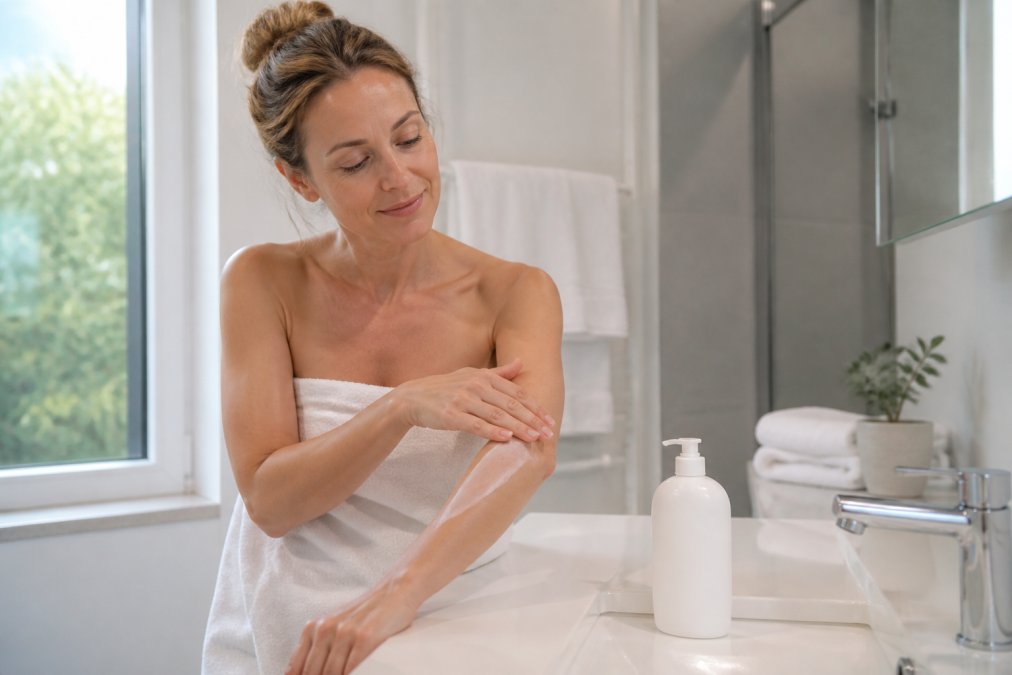
For the body, there is the hyaluron⁵ [smoothing body lotion(/products/hyaluron-smoothing-body-lotion) | wellmaxx-swiss.com] with 5-fold hyaluronic acid, macadamia nut oil, and vitamins. It is lightweight, absorbs quickly, and is specially designed for dry skin.
Lipids are also important for rebuilding the barrier. They fill the gaps in the lipid film left behind by UV radiation.
| Situation | First step | Suitable product | Time frame |
|---|---|---|---|
| Tightness right after the tanning bed | Cool and moisturize | Moisture gel | First 24 hours |
| Visible flaking skin | Avoid exfoliation, apply cream gently | Body lotion | 3 to 5 days |
| Persistent redness | Leave out irritants | Fragrance-free care | Until soothed |
| Decreasing elasticity | Rebuilding the skin barrier | Anti-aging set | Several weeks |
| New pigment spots | Dermatological evaluation | - | Promptly |
Conclusion
Dry skin after tanning bed use is treatable if you take the cause seriously. UV radiation damages the skin barrier, and regeneration takes time, moisture, and the right active ingredients. If you use the first 24 hours well and then continue the skincare routine consistently, you will see results faster.
That's exactly what Wellmaxx Swiss stands for: scientifically tested high-tech active ingredients, dermatest®-tested formulas, and over 5,000 satisfied customers. With the Hyaluron Anti-Aging Set, the super hydra boost concentrate, and the smoothing body lotion, you cover the face and body.
Discover now and give your skin what it really needs after sun exposure.
Frequently asked questions
What can I do about dry skin after sunbathing?
First cool the skin with lukewarm water and avoid hot showers. Then apply a moisture-binding lotion with hyaluronic acid or antioxidants while the skin is still slightly damp. This supports the moisture reserves and the recovery phase. Repeat the application two to three times a day until the feeling of tightness subsides and the skin barrier has recovered.
Which ingredients help with skin regeneration?
Hyaluronic acid binds water in the skin and supports moisture balance. Antioxidants such as vitamins protect against UV-induced stress, while marine collagen and apple stem cells strengthen resilience. Nourishing oils such as macadamia nut oil support the lipid balance. You should avoid alcohol-based products, harsh exfoliants, and heavily fragranced formulas, which can further irritate the skin barrier.
What should you definitely avoid after a tanning bed session?
Avoid hot showers, sauna sessions, and alcohol-based skincare products. Exfoliants and mechanical friction also irritate the skin further. Avoid exposing the skin to UV light any longer, as it is especially sensitive during the recovery phase. Instead, apply soothing after-sun care and give the skin at least 24 hours of rest before using SPF cream again.
How long should the skin rest after a tanning bed session?
Plan at least 24 to 48 hours of rest before exposing the skin to UV radiation again. During this time, skin regeneration is in full swing: the skin barrier rebuilds, moisture loss is balanced out, and sebum production normalizes. Support the recovery phase with moisturizing products and enough fluids so that skin elasticity returns more quickly.


